
How stress greys hair.
The nerves that drive fight-or-flight run directly into the melanocyte stem-cell niche. When they fire hard, the reservoir that renews hair colour empties in a rush — sometimes permanently, sometimes not.
From anecdote to mechanism.
For as long as people have noticed grey hair, they have told stories about it arriving after a shock. A night of fear, a year of grief, a captivity — and the hair is said to turn. The stories are stubborn because they are common, and dismissible because they sound like drama, not biology.
The problem was mechanical. It wasn't clear how a feeling could reach into a hair follicle and change its colour. Without a pathway, the observation floated between anecdote and myth.
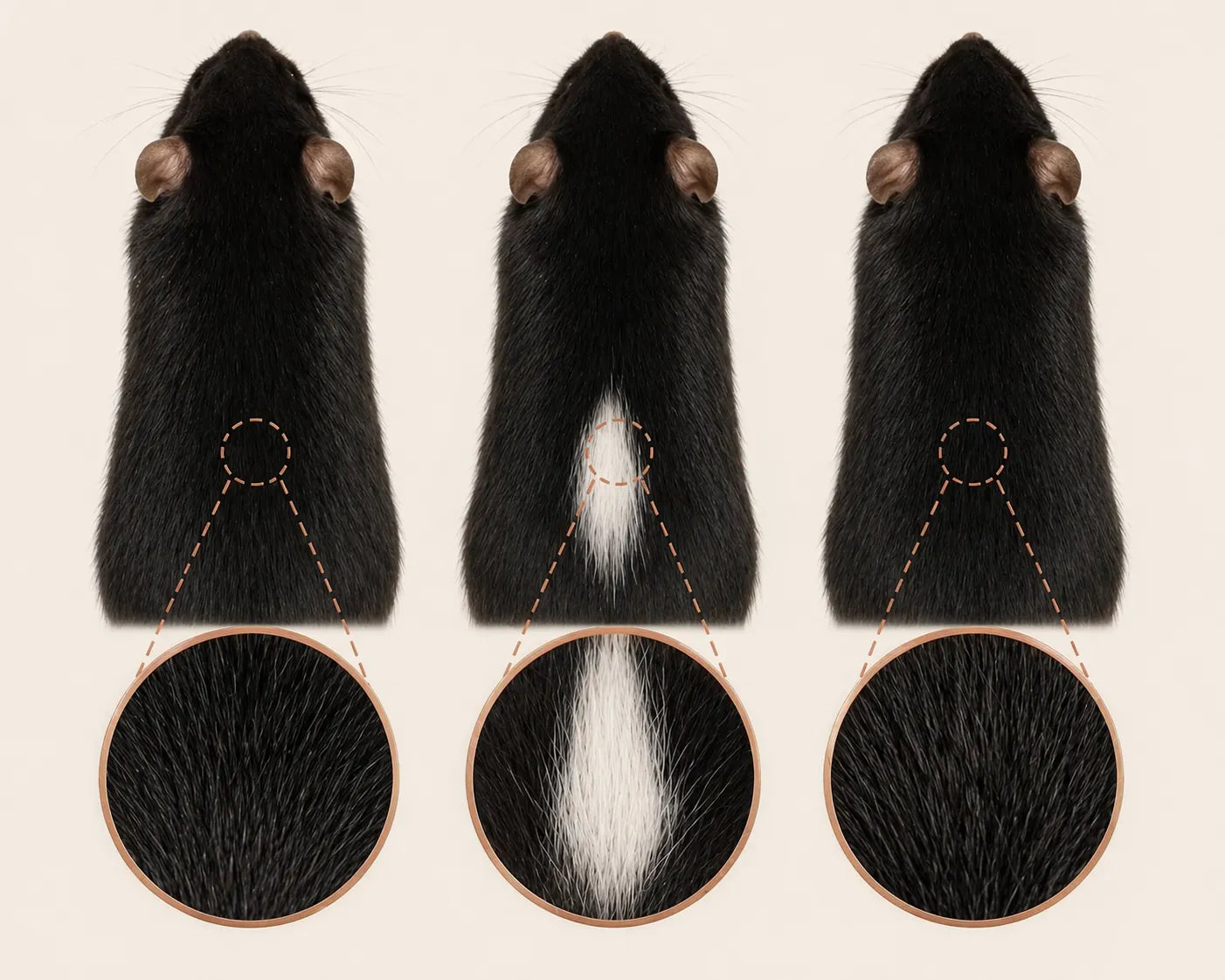
A 2020 study from Harvard changed that. Working in mice and tracing the signal step by step, researchers mapped a direct chain from psychological stress, through the sympathetic nerves, into the stem-cell reservoir that maintains pigment in every growing hair [Ref 1]. The stress didn't need the immune system. It didn't require cortisol as the primary driver. It was the nerves themselves — firing, releasing noradrenaline directly into the niche — that drained the pigment reserve [Ref 2].

What stress is, and which half reaches the follicle.
Stress is not a feeling. It is a whole-body programme — a set of co-ordinated physiological shifts that reshape how every organ is running, in service of a short, sharp response to threat.
Two branches of the autonomic nervous system handle the baseline. The sympathetic branch — fight or flight — raises heart rate, constricts blood vessels, and redirects resources toward muscle and brain. The parasympathetic branch — rest and digest — slows the heart and funds repair, digestion, and recovery. In ordinary life the two hold each other in balance.
Stress tips the balance hard toward the sympathetic side, and it does so through two arcs that unfold on different timescales. The first is nearly instantaneous: sympathetic nerves fire within seconds, releasing noradrenaline across every tissue they reach. The second is hormonal and slower: the brain activates the HPA axis, which releases cortisol into circulation over minutes and sustains a stress state for hours.
For a long time the cortisol arc was assumed to be the one that mattered for hair. The mouse work reframed that assumption without eliminating it. When the researchers removed the adrenal glands — and with them the ability to make cortisol — the stress-induced greying still happened. The main driver turned out to be the faster, nerve-driven arc, not the hormonal one. Cortisol still has broader effects on hair and skin biology and may contribute at the margins; what it is not, in this model, is the step that empties the pigment reservoir.
What makes hair colour, and what has to break.
Hair keeps its colour only as long as each follicle can keep renewing the cells that make pigment.
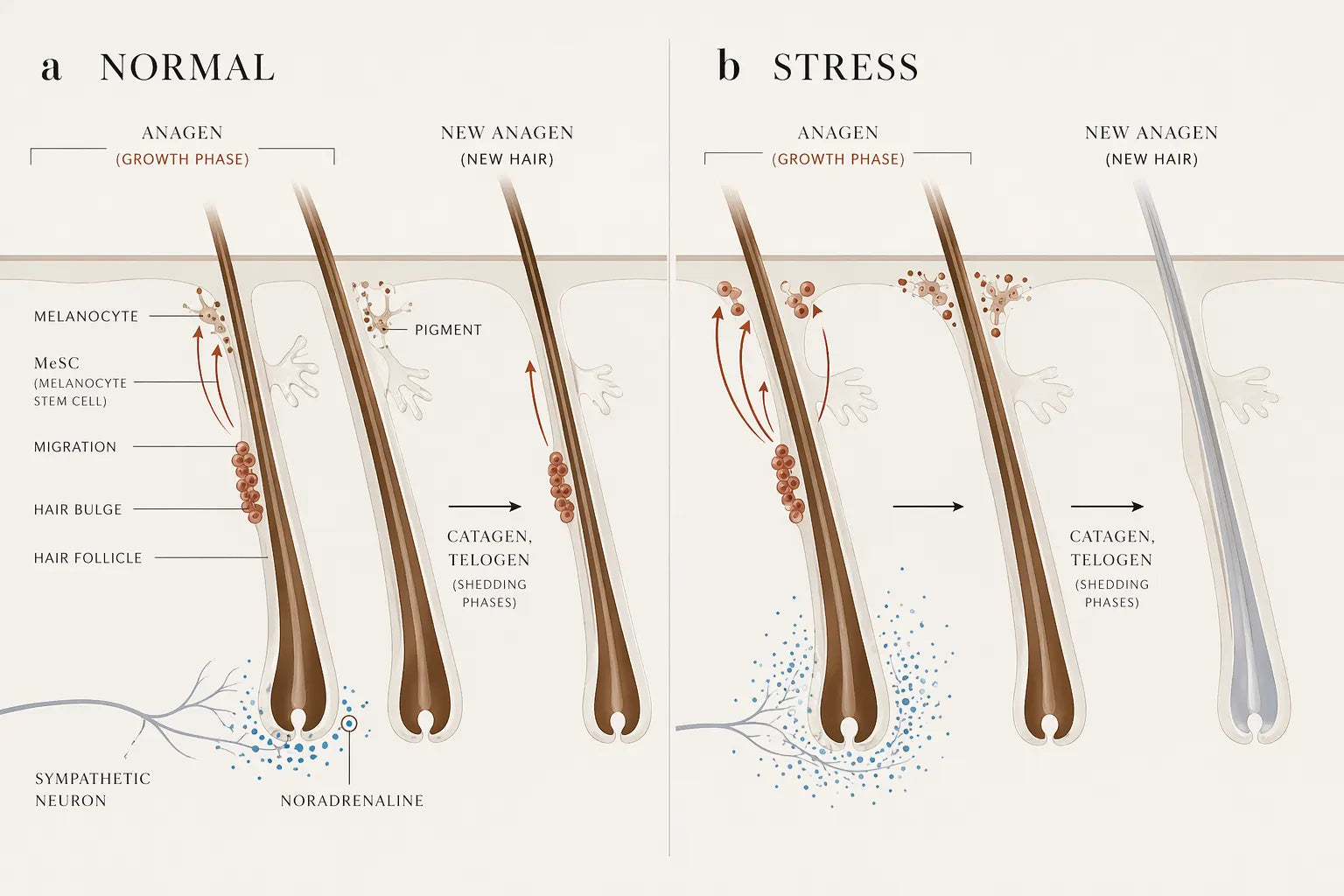
The pigment itself — melanin — is produced by melanocytes that load it into the growing shaft. Melanocytes don't last forever; they wear out and die on a schedule. What keeps the system running is a small reserve of melanocyte stem cells tucked into the bulge niche at the base of each follicle. At the start of every hair-cycle, a fraction of these stem cells wake up, migrate, and differentiate into fresh pigment-making cells. Others stay behind, quiet, to keep the reservoir populated for the next cycle.
The reservoir is finite. Its size is set early in life and drops slowly across decades as damage, error, and attrition take their share. When a given follicle's reservoir is exhausted — or too damaged to function — that follicle can no longer make pigment. The hair it grows comes in grey, and stays that way.
What makes the reservoir relevant to stress is where it sits and who it listens to. The bulge niche is wrapped tightly in sympathetic nerve fibres [Ref 2] — the same nerves that deliver fight-or-flight. This wiring is not incidental. It is the cable through which stress reaches pigment.
The collapse of the reserve.
In the Harvard experiments, acute intense stress flooded the niche with noradrenaline. The stem cells didn't die. They did something almost as final.
Normally, the reservoir replenishes itself slowly across many hair cycles — a few cells wake up each cycle, and the rest stay quiet. Under a surge of noradrenaline, the quiet cells are jolted awake all at once. A large fraction of the reservoir proliferates and differentiates in a single window, converts into pigment cells, and migrates out of the bulge to join the active compartment.
The follicle gets one pigmented cycle out of this spending spree. The reservoir, drained, doesn't repopulate. The next hair that grows from that follicle comes in grey, and so does the one after that.
The study isolated the step that mattered: the β₂-adrenergic receptor on the stem cells themselves. When the researchers genetically removed that receptor from the stem cells, noradrenaline had nothing to bind to — and the mice kept their hair colour even under the same stress protocol [Ref 1]. The signal is specific. The receptor is specific. The depletion is not a general toxic effect; it is a programmed response that happens to bankrupt the reservoir.
Severe stress does not bleach the hair already on the head. It spends the stem-cell savings account in a single shot, trading future pigment capacity for one extreme event.
In humans: bankruptcy in some follicles, a switch in others.
The mouse mechanism lined up with something humans had been quietly recording in their own hair. When researchers mapped pigmentation along individual human hairs — the single-hair method from Chapter 02 — some of the dark-to-grey transitions tracked episodes of acute stress almost exactly, and some of the grey-to-dark transitions tracked recovery [Ref 4].
That observation rules out a purely bankruptcy model of stress-related greying. In some follicles — almost certainly those sitting close to the greying threshold, with a reservoir still present — the noradrenergic signal is pulling a switch, not emptying a vault. Relieve the signal, and the switch can flip back.
The two findings are not in conflict. Severe stress, sustained or catastrophic, can deplete the reservoir and end pigment for that follicle. Milder, fluctuating stress can suppress pigment without destroying the reservoir, and is therefore, in principle, recoverable.
Bottom line.
Stress greys hair through a specific, measurable pathway: sympathetic nerves, noradrenaline, the β₂-adrenergic receptor on melanocyte stem cells, and the depletion of the pigment reservoir. The cortisol arc long assumed to be responsible is not the primary one — it may contribute at the margins, but it is not the step that empties the reserve. The cable that carries the damage is the fast-nerve arc, and the intervention surface is narrow — at the receptor, at the niche, or upstream at the stressor itself. The next chapter examines the cells on the receiving end of that signal, and what it takes to keep them alive long enough for the reservoir to refill.
- № 01 Why hair turns grey.The cascade of six compounding failures at the follicle.
- № 02 Is hair greying permanent?The half of the cascade that can still be undone.
- № 04 Saving the cells behind hair colour.On Luteolin and the window to intervene before the reservoir runs out.
- № 05 When cells stop talking.Signalling failure at the follicle — Wnt, Endothelin-1, and the quiet collapse of coordination.
-
(2020). Hyperactivation of sympathetic nerves drives depletion of melanocyte stem cells. Nature.Read ↗
-
(2020). Solving a biological puzzle: how stress causes grey hair. Harvard Stem Cell Institute.Read ↗
-
(2020). Fight or flight turns hair white. Nature.Read ↗
-
(2021). Quantitative mapping of human hair greying and reversal in relation to life-stress. eLife.Read ↗