
Saving the cells behind hair colour.
Most anti-greying candidates never survive contact with the biology. Luteolin did. Tested in a mouse line engineered to reproduce the exact stem-cell-reserve failure that drives human greying, a plant flavonoid called Luteolin slowed the build-up of grey hair by lowering oxidative stress in the follicle and preserving the niche signals that keep the pigment reserve alive. It is the cleanest positive result the field has on file.
Moving beyond the myths.
For most of the last century, the search for an anti-greying remedy looked more like a category of marketing than a branch of biology. Vitamins, oils, supplements, tonics — promoted with confidence, tested with almost none.
The obstacle was partly structural. True age-related greying unfolds across decades, which makes any human trial slow, expensive, and prone to confounding. So the field drifted toward claims that didn't need to be proved — or couldn't be.
What changed is the resolution. Over the last fifteen years, research has narrowed greying down from a vague aesthetic decline to a specific, staged failure: the melanocyte stem-cell reserve is not adequately maintained, niche signalling weakens, and the follicle's capacity to renew pigment gradually runs out (see Why hair turns grey).
With the cascade mapped, candidate molecules can be assessed on real criteria: do they protect the reserve, do they support niche signalling, do they slow greying in a model where greying is actually happening? That is the frame in which Luteolin, a plant-derived flavonoid, has emerged as the first concrete candidate with evidence behind it [Ref 1].
Antioxidants behave like spark extinguishers. They keep the normal bursts of oxidative activity inside a cell from accumulating into chronic wear on its DNA, its membranes, and its machinery.
The two forces that empty the reservoir.
Two forces do most of the damage to the follicle across a lifetime: oxidative stress, and the slow breakdown of the local signals that keep pigment stem cells working.
Oxidative stress is chemical wear. During normal metabolism — and under UV, inflammation, or pollution — cells produce reactive oxygen species. In small amounts these are useful signalling molecules. In excess they damage DNA, fats, and proteins, and they accelerate the ageing of any cell lineage that has to keep dividing. In hair follicles, oxidative stress tracks faster wear in pigment cells, weaker melanin production, and a less supportive niche [Ref 2].
Niche signalling is the second force. The pigment stem-cell reserve doesn't self-manage in isolation — it depends on short-range cues from neighbouring cells that keep it alive, keep it in the right state, and release a controlled fraction at the right moment in the hair cycle. When those cues weaken, the reserve can remain in place but becomes harder to maintain and harder to deploy on time. The full signalling story is covered in When cells stop talking.
A serious anti-greying candidate has to touch both. Luteolin was tested on exactly this dual criterion.
A mouse that greys like we do.
Testing an anti-greying molecule requires a model that actually greys — gradually, reproducibly, and through the same biology that drives colour loss in humans. Ordinary mouse strains don't. They grey patchily, or slowly, or only in response to one-off insults, which makes it impossible to tell whether a candidate is protecting the pigment reserve or simply buffering a single stressor.
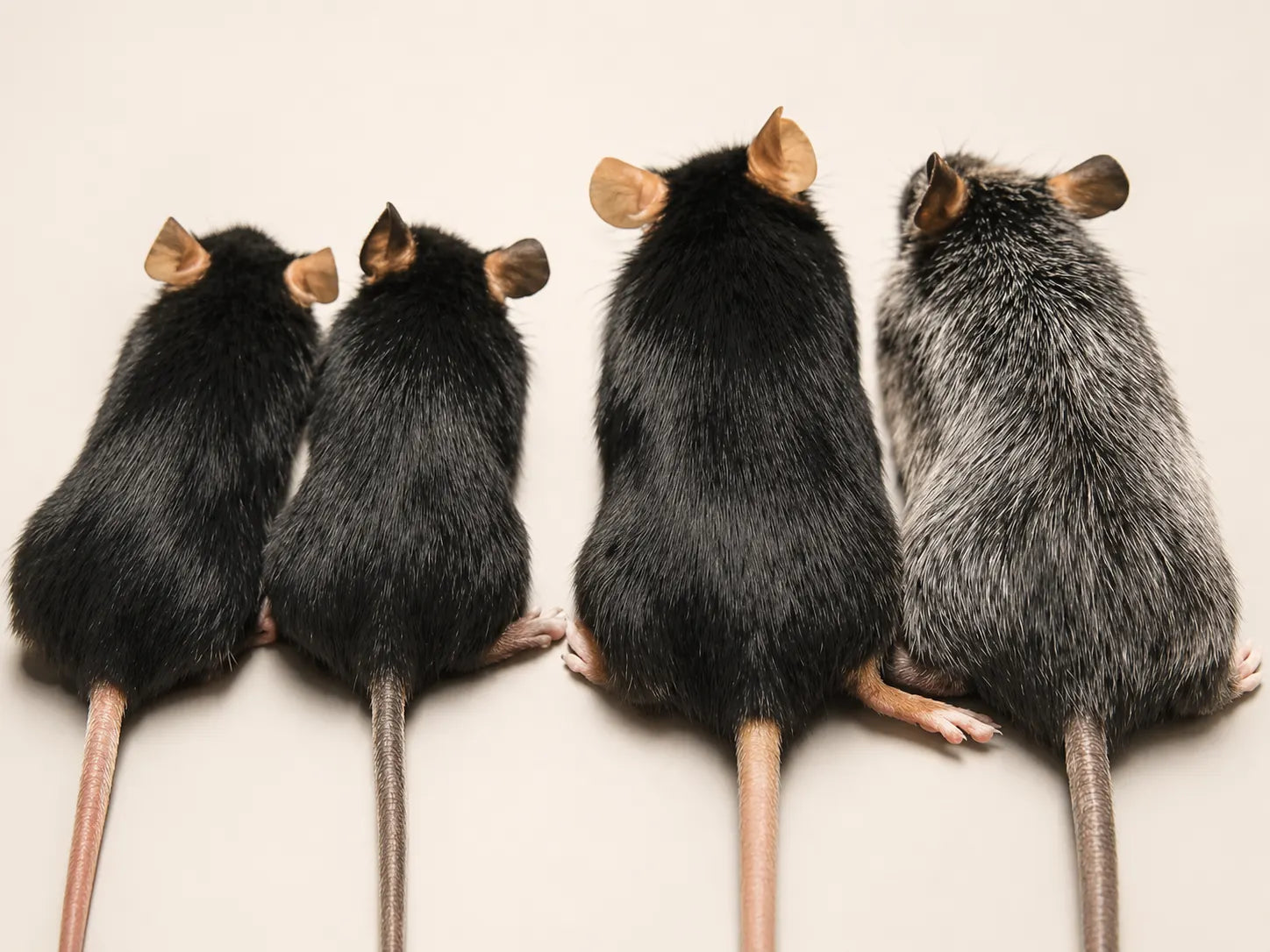
The RET mouse was engineered to close that gap [Ref 3]. A persistent RET-kinase signal applies continuous low-level pressure on the follicle across repeated hair cycles — compressing the same cumulative wear that accumulates across a human scalp over decades into a lifespan that can be tracked week by week in a lab. The result is a mouse that starts pigmented and accumulates grey hairs progressively, on a predictable slope, through the exact pathway that matters in people: the slow attrition of the melanocyte stem-cell reserve.
That is the point. The RET mouse is not a convenient substitute for a human. It is a purpose-built replica of the specific failure mode behind human greying, chosen so that a positive result inside it counts as evidence about the failure mode itself.
The RET mouse is not a generic animal model. It was engineered to reproduce the specific stem-cell-reserve failure behind human greying — so a result inside it is a result about the failure mode itself.
The experimental grid.
Using RET-mice as a living timeline, the team followed two groups from youth into old age. At defined ages they plucked a standardised sample of trunk hair — 100 hairs per animal — and classified each as pigmented or grey. Small skin biopsies let them compare, cycle by cycle, what was happening inside dark follicles versus grey ones: how many melanocyte stem cells were left in the niche, how many differentiated melanocytes reached the bulb, and how the local environment was changing around them.
That grid — many ages, two strains, dark and grey follicles side by side — is what made Luteolin testable in the first place. Without the timeline, any intervention looks like a snapshot. With it, the question becomes measurable: does the candidate bend the greying curve relative to untreated controls?
What Luteolin did — and what its close relatives didn't.
Luteolin was tested in two routes: a 1% topical solution applied to shaved skin, and oral administration mixed into the feed. Both routes slowed greying.
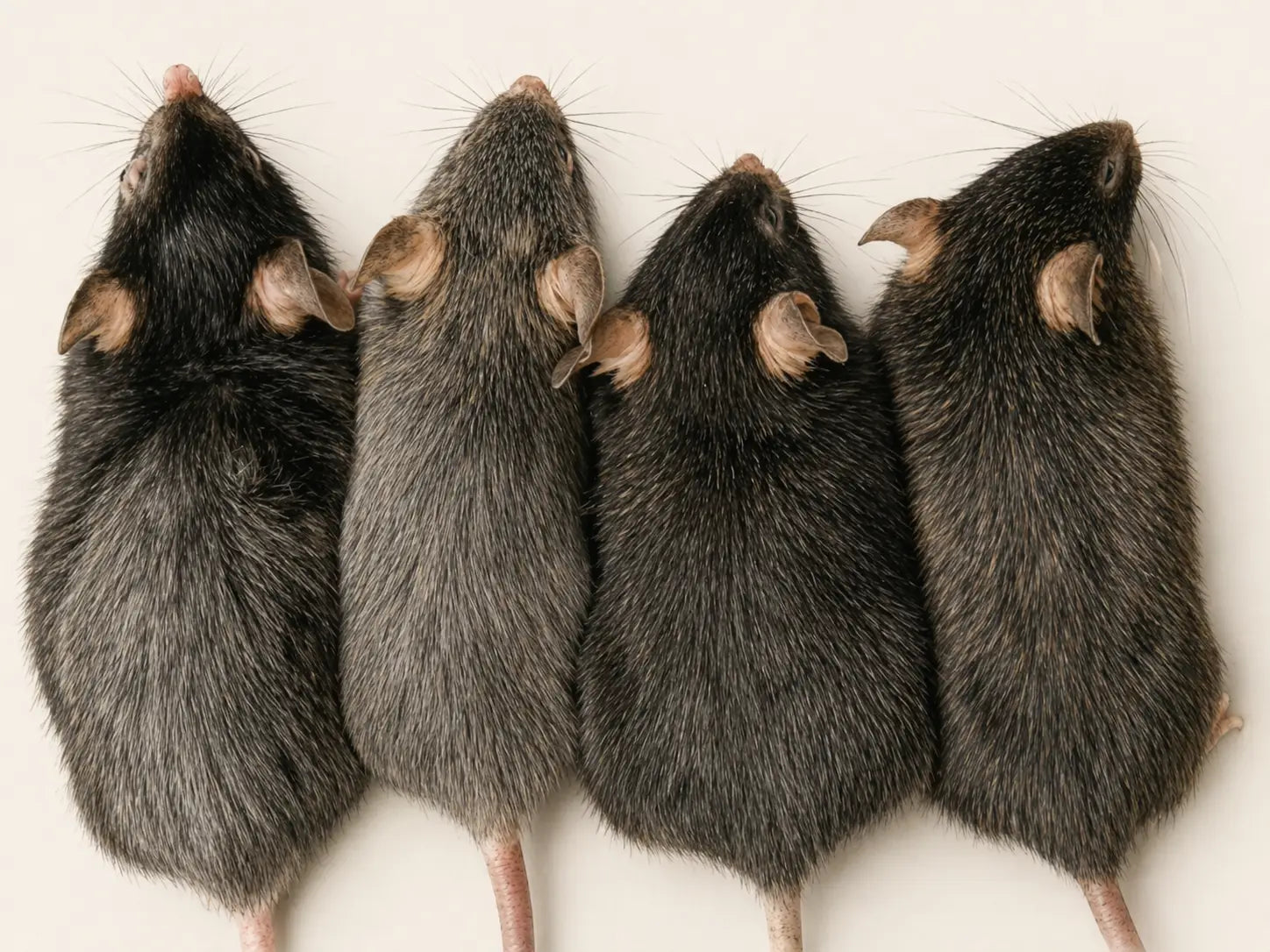
Mice receiving Luteolin accumulated grey hairs more slowly than untreated controls across the observation window. Inside the follicles, the mechanism was visible under the microscope: more melanocyte stem cells were retained in the bulge niche, and more differentiated melanocytes were present in the bulb, meaning the follicles could stay in pigment-making mode for longer [Ref 1].
The specificity test mattered more than the primary result. The team repeated the protocol with two structurally close flavonoids — Hesperetin and Diosmetin. Neither slowed greying. Neither preserved the stem-cell reserve in the same way. In this model, Luteolin was the only flavonoid that measurably bent the curve.
That two close chemical relatives did nothing is the signal. It means Luteolin's effect isn't a generic antioxidant one — there is something more specific about how it acts on the niche.
Why this is the signal we needed.
The conventional disclaimer about animal studies — that a finding in a mouse is not a finding in a person — is doing less work here than it usually does, because the model was built to solve exactly that problem.
The RET mouse compresses the human-relevant pathway onto an experimental timeline: the same stem-cell-reserve collapse, through the same oxidative and signalling failures, producing the same outcome of progressive greying. That is the pathway Luteolin protected. The molecule is defined. The cell population it acts on is defined. The two mechanisms — oxidative protection and niche signalling — are conserved between the two species at the layer of biology the compound actually engages.
This is the tightest biological fit an anti-greying candidate has been held to. The remaining step is replication on human scalps over a human timeline, which is the kind of work that takes years and is under way. The signal we were waiting for — a molecule with a mapped mechanism and a positive result in a model engineered to test it — is on file.
Bottom line.
Luteolin was not proposed as an anti-greying candidate and then left to marketing. It was tested inside a mouse line built to replicate the exact failure mode behind human greying, against close chemical controls, and it slowed the build-up of grey hair by protecting the pigment stem-cell reserve — specifically, by reducing oxidative wear and preserving the niche signals that keep the reserve renewable. The effect was route-independent and not reproduced by its near-neighbours. Read in context, it is the first serious positive result the field has had in a model that deserves the weight. The next chapter examines the signalling layer directly — why the niche's local conversation matters so much, and what happens when it falters.
- № 01 Why hair turns grey.The cascade of six compounding failures at the follicle.
- № 02 Is hair greying permanent?The half of the cascade that can still be undone.
- № 03 How stress greys hair.The nerve-driven arc that empties the pigment reserve in a single shot.
- № 05 When cells stop talking.Signalling failure at the follicle — Wnt, Endothelin-1, and the quiet collapse of coordination.
-
(2024). Anti-graying effects of external and internal treatments with Luteolin on hair in model mice. Antioxidants, 13(12):1549.Read ↗
-
(2025). Gray hair: from preventive to treatment. Clinical, Cosmetic and Investigational Dermatology, 18:1475–1494.Read ↗
-
(2020). Hair graying with aging in mice carrying oncogenic RET. Aging Cell, 19(11):e13273.Read ↗